Categories
Important Links
- Meian Technology
- Hengbo security technology
- HST fire alarm system manufacturer
- Home Security and Smart Home
- Dropshipping
- Security service alarm video server
- How to Choose an Infrared Beam Detector
- New equipment for outdoor security
- How to debug infrared beam alarm
- Infrared Beam VS. Microwave Beam Detection
- UV flame detector
- Wireless Community Alarm System
Solar-powered alarm and monitoring system
The solar-powered alarm and 4G/5G monitoring system is the best security system for outdoor security, especially for farms and ranches in remote areas without electricity or internet.
According to the latest report from Fortune Business Insights, the global solar-powered camera market reached a value of $1.12 billion in 2023 and is expected to continue expanding at a compound annual growth rate (CAGR) of 10.4%, reaching $2.73 billion by 2032. Another authoritative institution, Market Research Future, predicts that the CAGR will remain around 13.5% from 2023 to 2032. This rapid growth is not groundless; it is driven by the inherent limitations of traditional wired surveillance solutions in vast "off-grid" scenarios, and is an inevitable result of the mature convergence of solar energy, wireless communication, and Internet of Things (IoT) technologies.
Solar-powered 4G cameras, which require no complex wiring, have become the most economical and efficient solution for achieving public safety coverage, monitoring farmland and fish ponds, and preventing theft in courtyards.
Advancements in photovoltaic technology have enabled miniaturized and high-efficiency solar panels to power cameras for uninterrupted operation day and night. Meanwhile, the widespread adoption and cost reduction of lithium-ion energy storage technology have addressed the power supply challenges during nights and consecutive rainy days. More importantly, the extensive coverage and reduced costs of 4G/5G networks provide a stable, high-speed, and manageable channel for data transmission, completely freeing devices from geographical constraints.
This integrated model of "solar power supply + wireless transmission + intelligent analysis" brings significant total cost of ownership (TCO) advantages. Taking a remote pasture monitoring project far from the power grid as an example, the traditional solution requires excavating trenches, laying several kilometers of cables, and applying for municipal power access, with huge initial investment and lengthy construction period. However, the solar wireless solution achieves "install and use immediately", with only minimal network traffic fees and occasional remote maintenance required in the later stages. This disruptive cost structure makes it the only viable option in scenarios such as smart agriculture, border patrol, oil pipeline monitoring, and temporary site management.
The role of solar-powered surveillance cameras has long surpassed the traditional "guarding" and "anti-theft" functions. It is evolving into a multifunctional IoT node that integrates video, data collection, and transmission.
In the field of smart agriculture, many large-scale farmers in Australia not only utilize these technologies to prevent theft but also integrate soil moisture and weather sensors to achieve intelligent linkage of irrigation systems and disaster warnings. In terms of environmental protection and scientific research, these devices play an irreplaceable role in protecting endangered species and monitoring forest fire risks. In the home DIY security market, consumer-grade products launched by brands represented by Reolink and Eufy continue to sell well on e-commerce platforms, demonstrating their strong appeal among ordinary users.
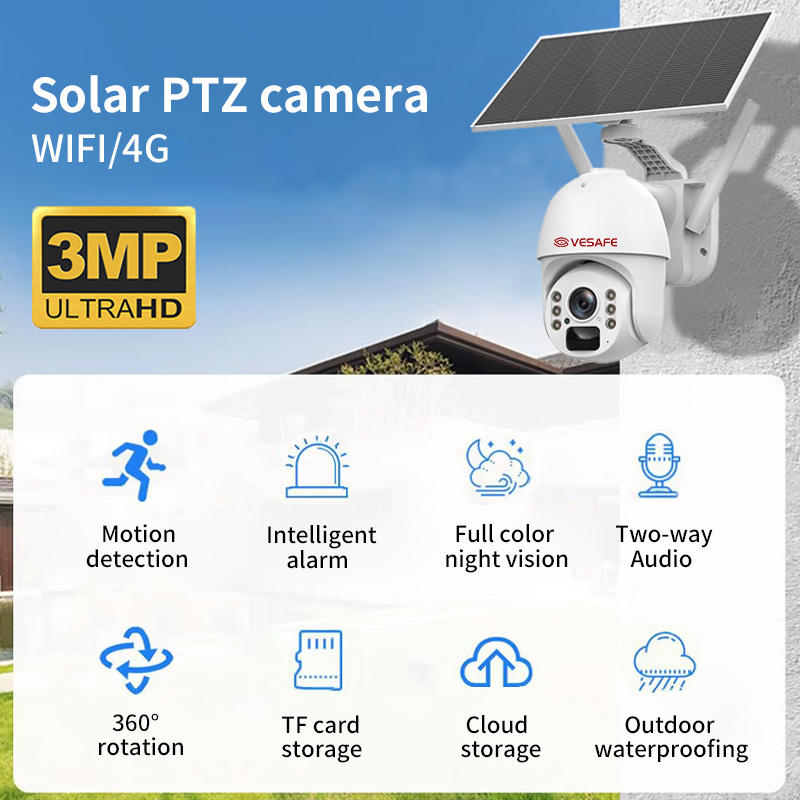
Meanwhile, the increase in public security investment globally, the advancement of rural revitalization strategies, and the active promotion of IoT services by telecom operators have jointly created a perfect market nurturing environment. For instance, in Southeast Asia and certain African countries, governments have collaborated with telecom operators to promote solar energy monitoring as a basic service for "smart cities", achieving leapfrog development in security infrastructure.
In the future, solar-powered security surveillance will exhibit three major trends:
Intelligent deep integration: AI capabilities will be further pushed to the device side, enabling more accurate person-vehicle classification and behavior analysis, while saving traffic and improving response speed.
Refined energy management: Through AI algorithms to predict weather and intelligently schedule equipment operating modes (such as scheduled hibernation, motion detection wake-up), adaptive optimization of energy is achieved, enhancing the endurance in rainy environments.
Platformization and Ecologization: Devices will no longer be isolated points, but will be deeply integrated into smart cities, smart agriculture, and industrial Internet platforms, serving as data entry points and linking with drones, sensor networks, and business management systems to create value beyond security itself.